
Parmigianino, born Francesco Mazzola in 1503 in Parma, Italy, stands as one of the quintessential figures of the Mannerist movement in art.

Table of Contents
- Introduction
- Life and Education of Parmigianino
- The Mannerist Movement
- Notable Works of Parmigianino
- Parmigianino’s Innovations and Techniques
- Influence and Legacy
- Conclusion
- Questions and Answers
Introduction
Celebrated for his innovative approaches to composition, perspective, and figuration, Parmigianino’s work marks a significant departure from the harmonious proportions and balanced compositions characteristic of the High Renaissance. His artistry, characterized by elegant elongation of forms, intricate poses, and a nuanced play of light and shadow, captures the essence of Mannerism’s exploration of beauty and expressiveness beyond the classical norms. This introduction aims to set the stage for a deeper exploration of Parmigianino’s life, his contributions to the Mannerist style, and his enduring impact on the trajectory of European art.
Life and Education of Parmigianino
Parmigianino’s artistic journey began in Parma, where he was born into a family with artistic leanings. His father, Filippo Mazzola, was also a painter, providing an early environment conducive to his artistic development. From a young age, Parmigianino demonstrated prodigious talent, prompting his uncles, who were painters themselves, to oversee his training. His early exposure to the works of Correggio, a master of the Italian Renaissance, in Parma, significantly influenced his stylistic development.
By the age of 16, Parmigianino had already produced notable works, showcasing his mastery over drawing and painting. His career took a significant turn when he moved to Rome in 1524, seeking to study the works of Raphael and Michelangelo. However, his stay in Rome was cut short by the Sack of Rome in 1527, forcing him to return to Bologna and later to Parma. It was during these tumultuous years that Parmigianino’s unique style began to flourish, merging the influence of his early experiences with his personal vision, thus contributing significantly to the Mannerist movement.
The Mannerist Movement
Mannerism, emerging in the late Italian Renaissance around the 1520s, represented a departure from the idealized beauty and harmonious proportions of the High Renaissance. This movement embraced a more subjective, expressive approach to art, characterized by exaggerated proportions, complex compositions, and a heightened sense of drama and tension. Parmigianino, with his penchant for elongation of forms and innovative use of perspective, emerged as a leading figure in this movement.
His works exemplify the Mannerist fascination with distortion and elegance, pushing the boundaries of traditional representation. Parmigianino’s art does not merely seek to replicate nature but rather explores the potential of form and space to convey complex emotional and aesthetic experiences. This exploration of the boundaries of artistic expression places Parmigianino at the heart of the Mannerist movement, making his contributions pivotal to understanding its development and impact.
Notable Works of Parmigianino
Parmigianino, a key figure in the Mannerist movement, created several works that have been celebrated for their innovative approach and contribution to art history. Below are five notable works that encapsulate his mastery and influence:
“Madonna with the Long Neck” (1534–40)
This iconic painting, housed in the Uffizi Gallery, Florence, is perhaps Parmigianino’s most famous work. It is distinguished by the Madonna’s elongated neck and the unusual proportions of the figures, showcasing Parmigianino’s signature style that emphasizes grace and elegance beyond naturalistic representation.

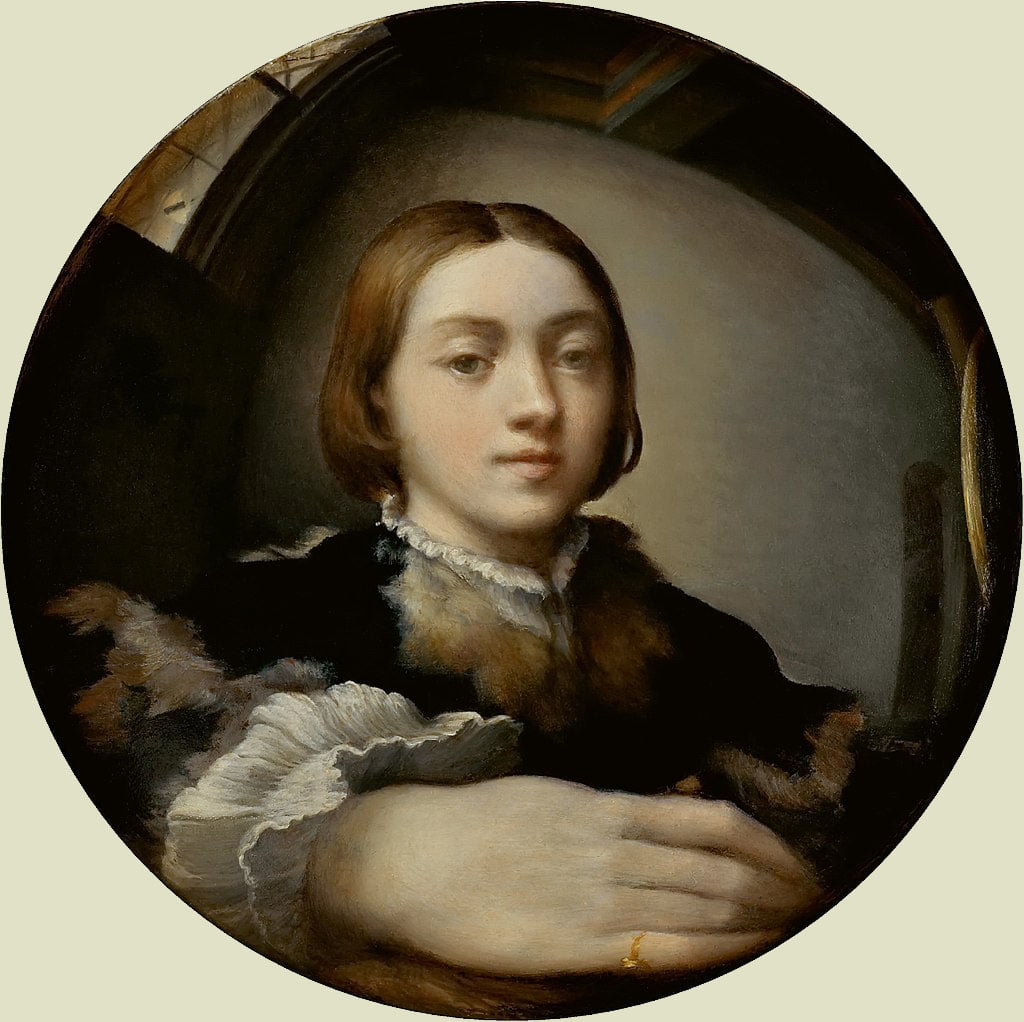
“Self-Portrait in a Convex Mirror” (c. 1524)
A testament to Parmigianino’s experimental approach, this painting captures the artist’s reflection in a convex mirror, offering a distorted perspective that was groundbreaking at the time. It demonstrates his interest in optical effects and perspective, making it a pivotal piece in the study of self-portraiture.
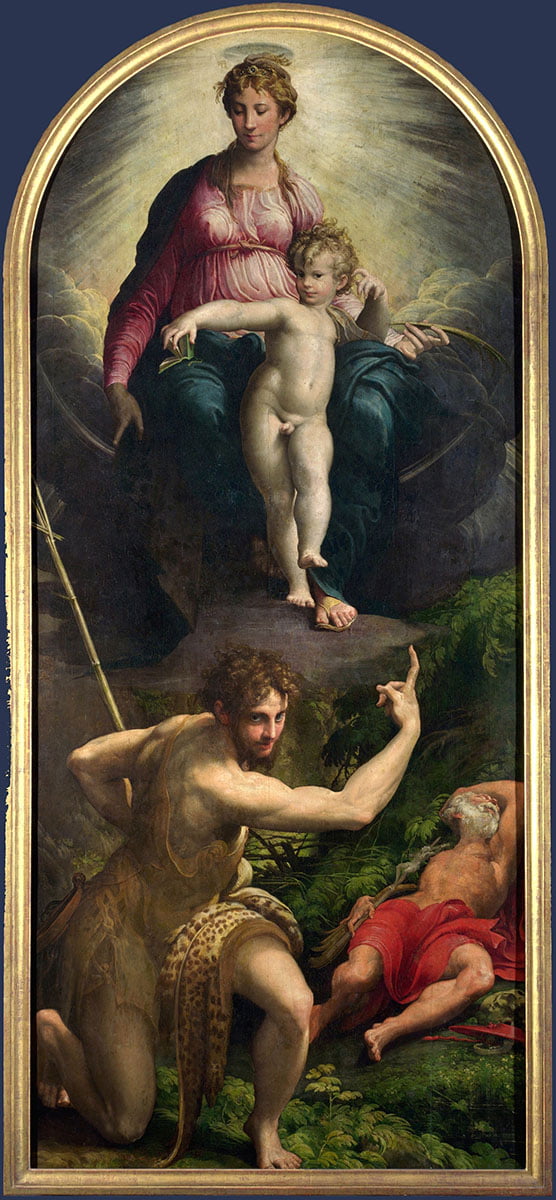
“The Vision of Saint Jerome” (1527)
This work, which features Saint Jerome receiving a vision, is noted for its dramatic use of light and shadow, as well as the dynamic composition that guides the viewer’s eye across the scene. The saint’s elongated limbs and the detailed rendering of textures showcase Parmigianino’s skill in creating visually compelling religious narratives.
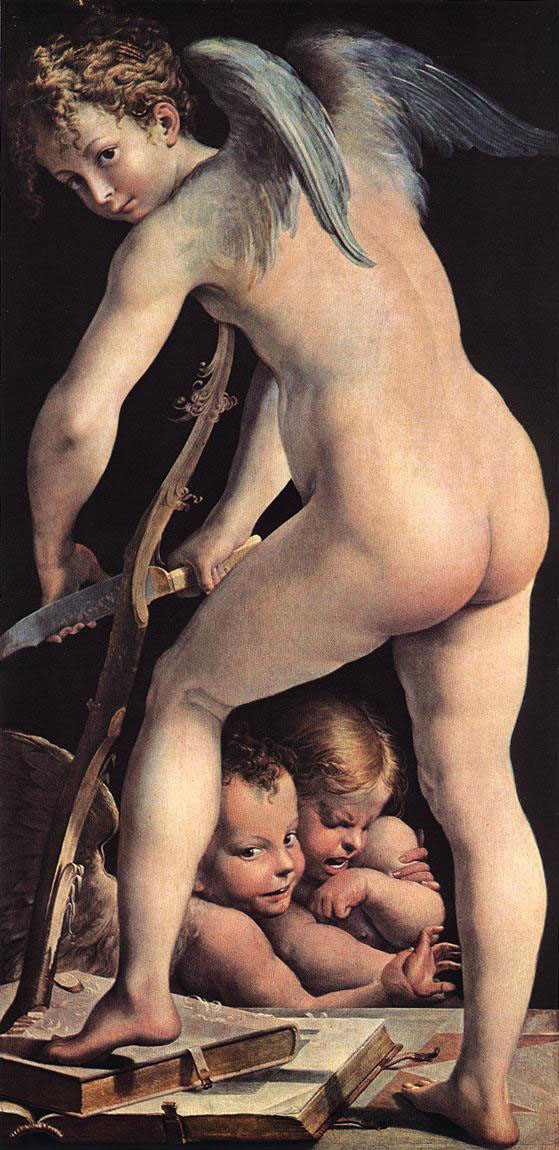
“Cupid Carving His Bow” (1533–1535)
Exhibiting Parmigianino’s talent for capturing the beauty of the human form, this painting portrays Cupid engaged in the delicate task of carving his bow. The fluidity of the figure and the intricate details of the setting highlight Parmigianino’s ability to infuse mythological subjects with a sense of immediacy and finesse.
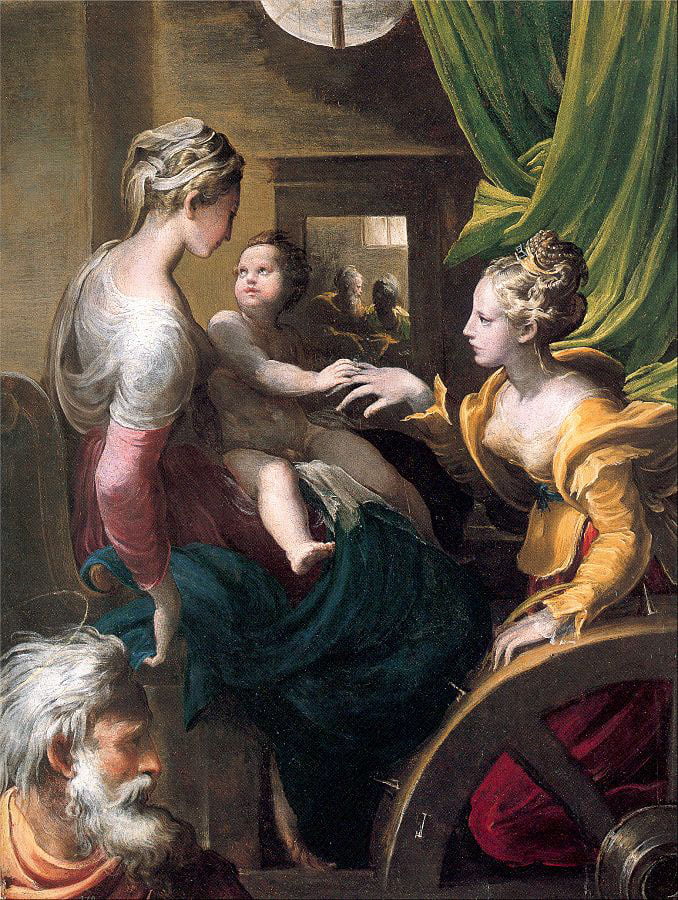
“The Mystical Marriage of Saint Catherine” (c. 1529)
This painting illustrates the spiritual union of Saint Catherine of Alexandria with Christ, surrounded by saints and angels. Parmigianino’s use of color, light, and spatial arrangement in this work contributes to its serene and harmonious composition, embodying the spiritual depth and complexity of the scene.
These works collectively represent the breadth of Parmigianino’s artistic achievements, from religious and mythological subjects to innovative self-portraiture. His ability to manipulate form, perspective, and light not only defined his contributions to the Mannerist movement but also left a lasting legacy that continued to influence artists long after his time.
Parmigianino’s Innovations and Techniques
Parmigianino’s contribution to art extends beyond his thematic choices to include significant technical and stylistic innovations. His use of elongation, for instance, was not merely a stylistic preference but a deliberate attempt to infuse his figures with a sense of grace and otherworldly beauty. This manipulation of form serves to heighten the emotional impact of his works, creating a tension between the familiar and the sublime.
Furthermore, Parmigianino’s experimentation with perspective and his innovative use of light and shadow contribute to the distinctive atmosphere of his paintings. His skillful manipulation of chiaroscuro (the contrast between light and dark) adds depth and intensity to his compositions, enhancing their emotional resonance and visual impact.
Parmigianino’s attention to detail and his exploration of unconventional perspectives are also evident in his drawings and etchings. His preparatory sketches reveal a meticulous approach to composition and form, highlighting his ability to experiment and refine his ideas through drawing. Additionally, Parmigianino’s engagement with printmaking allowed him to disseminate his innovative techniques and stylistic approaches more broadly, influencing a wide range of artists across Europe.
His technique of sfumato, a subtle gradation of tone used to blur the lines between objects, further exemplifies his innovative approach to painting. This technique, while also utilized by his predecessors, was pushed to new extremes by Parmigianino, creating ethereal and dream-like qualities in his works that defy precise definition and engage viewers in a more immersive aesthetic experience.
Influence and Legacy
Parmigianino’s influence extends well beyond his lifetime, with his innovative approaches to composition, perspective, and form influencing subsequent generations of artists. His distinctive style and techniques contributed significantly to the development of the Mannerist movement and laid the groundwork for the Baroque period that followed. Artists such as El Greco, who is known for his elongated figures and expressive use of color and light, demonstrate the lasting impact of Parmigianino’s innovations.
Moreover, Parmigianino’s work has continued to captivate art historians and enthusiasts, drawn to his unique blend of technical mastery and aesthetic exploration. His contributions to the Mannerist style are considered crucial in the transition from the High Renaissance to the more expressive and dynamic approaches of later periods. The enduring fascination with Parmigianino’s work underscores the timeless appeal of his artistic vision and the continued relevance of his innovations.
Conclusion
Parmigianino stands as a pivotal figure in the history of art, whose innovative contributions to the Mannerist movement have left an indelible mark on the visual arts. Through his exploration of form, perspective, and light, Parmigianino pushed the boundaries of artistic expression, challenging conventional notions of beauty and composition. His works, characterized by their elegance, complexity, and emotional depth, continue to inspire and intrigue audiences, reflecting the enduring power of art to transcend its historical context and speak to universal human experiences. Parmigianino’s legacy as the innovator of the Mannerist style reaffirms his place among the great masters of the Renaissance, highlighting the importance of creativity and experimentation in the evolution of art.
Questions and Answers
Q: What did Parmigianino look like?
Parmigianino’s appearance is best known through his “Self-Portrait in a Convex Mirror,” which depicts him as a young man with a thoughtful expression, showcasing his delicate facial features, long curly hair, and a gaze that reflects both introspection and confidence. This self-portrait, while distorted due to the convex surface it is painted on, provides a rare glimpse into the artist’s physical appearance and personality.
Q: What Mannerist conventions did Parmigianino use in “Madonna with the Long Neck”?
In “Madonna with the Long Neck,” Parmigianino employed several Mannerist conventions that distinguish the painting as a masterpiece of the style. These include:
Elongated Figures: The Madonna, in particular, is depicted with an unnaturally long neck and extended limbs, a hallmark of Mannerist figural distortion intended to convey elegance and grace.
Unusual Composition: The composition of the painting is intentionally imbalanced, with the Madonna and child off-center and a crowded group of angels on one side, creating a sense of dynamism and tension.
Ambiguous Space: The spatial arrangement in the painting is unclear, with a disproportionately small column in the background and an undefined space around the figures, challenging traditional perspectives.
Rich Color and Light: The use of vivid colors and the contrast between light and shadow enhance the painting’s dramatic and emotional impact, drawing viewers into the scene.
These Mannerist conventions reflect Parmigianino’s innovative approach to art, challenging conventional norms to explore new aesthetic possibilities and convey complex emotional states.
Q: What defines the Mannerist style that Parmigianino was a part of?
The Mannerist style is characterized by its departure from the proportional and harmonious ideals of the High Renaissance, embracing instead exaggerated forms, complex compositions, and a heightened sense of emotion and drama. Parmigianino’s work, with its elongated figures and innovative use of perspective, exemplifies the Mannerist aesthetic.
Q: How did Parmigianino influence future art movements?
Parmigianino’s innovative techniques and stylistic choices influenced the development of the Mannerist movement and laid the groundwork for the Baroque period. His work has inspired a wide range of artists across Europe, demonstrating the lasting impact of his approach to form, light, and perspective.
Q: What makes Parmigianino’s “Madonna with the Long Neck” so unique?
“Madonna with the Long Neck” is celebrated for its unconventional composition, elongated figures, and the ethereal quality of its subjects. These elements reflect Parmigianino’s departure from traditional representations, offering a new interpretation of religious iconography that is both innovative and captivating.