
The Catholic Church boasts a rich tapestry of saints, each with their unique stories, virtues, and contributions. These saints serve as spiritual guides, bridging the temporal and the eternal, and guiding believers towards a closer relationship with the divine. Their lives, marked by sacrifice, devotion, and unwavering faith, have been immortalized not just in sacred scriptures but also in the annals of art. Paintings capturing their essence, trials, and miracles adorn churches and galleries worldwide, serving as visual testimonies to their legacies. This article delves into the lives of ten famous catholic saints, exploring their stories and the art that celebrates them.

Table of Contents :
- The Virgin Mary: Mother of Jesus and Queen of Saints
- Saint George: The Dragon-Slaying Martyr
- Saint Blandina: The Courageous Martyr of Lyon
- Saint Francis of Assisi: The Nature-loving Friar
- Saint Thomas Aquinas: The Scholarly Saint
- Saint Anthony of Padua: The Miracle Worker
- Saint Therese of Lisieux: The Little Flower of Jesus
- Saint Augustine of Hippo: The Converted Sinner
- Saint Catherine of Siena: The Mystic and Political Activist
- Saint Ignatius of Loyola: The Founder of Jesuits
- Questions and Answers
The Virgin Mary: Mother of Jesus and Queen of Saints
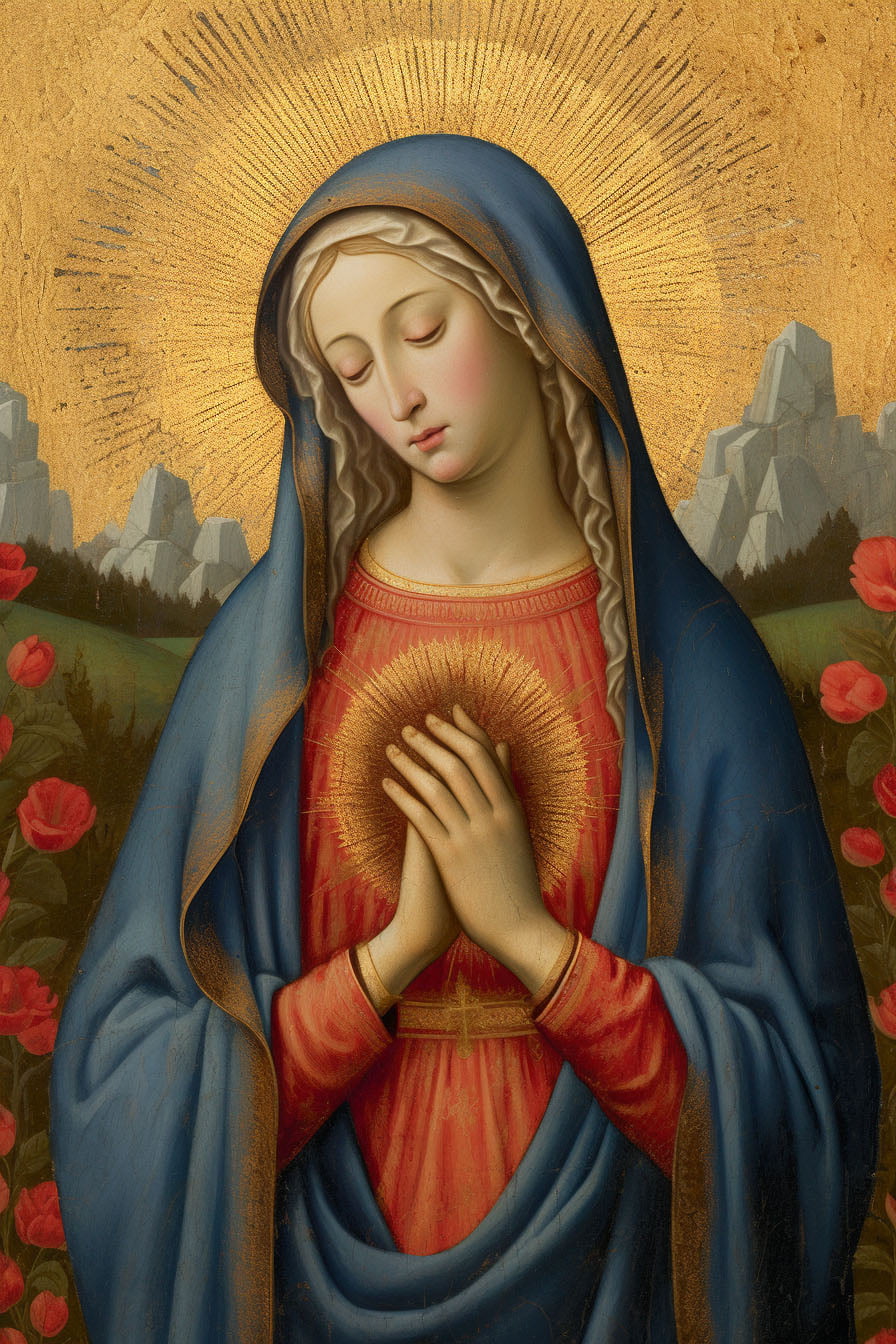
Mary, often referred to as the Blessed Virgin Mary, is a central figure in Christian theology and spirituality. Her role as the mother of Jesus Christ, the savior of humanity, places her in a unique and revered position. Throughout the New Testament, Mary is depicted as a woman of faith, courage, and humility. The Annunciation, where the Angel Gabriel visits Mary to announce that she will conceive Jesus, is a testament to her unwavering faith and acceptance of God’s will.
In Catholicism, Mary is venerated not just as the mother of Jesus but also as the Mother of the Church. Her “yes” to God, her Magnificat, her presence at the foot of the cross, and her assumption into heaven are significant events that highlight her role in the story of salvation. Her intercessory prayers are believed to hold a special place in the heart of her son, Jesus, making her an advocate for all believers.
Artistically, the Virgin Mary has been a muse for countless artists throughout history. Her depictions in art capture various facets of her life and her virtues. One of the most iconic representations of Mary is the “Madonna and Child”, showcasing the tender bond between mother and son. Artists like Raphael, Leonardo da Vinci, and Michelangelo have all presented their interpretations of this theme. Another profound depiction is the “Pieta” by Michelangelo, housed in St. Peter’s Basilica, showcasing a grieving Mary holding the lifeless body of Jesus after the crucifixion.
Furthermore, the Annunciation has been a favored subject, capturing the moment of divine intervention in human history. Paintings like “The Annunciation” by Fra Angelico elegantly portray this celestial event, emphasizing the serenity and grace of the Virgin Mary.
In addition to these, the “Assumption of Mary”, where she is taken bodily into heaven, has been depicted in numerous frescoes, paintings, and sculptures, emphasizing her purity and her unique role in Christian history.
Mary’s life, filled with faith, trials, joys, and sorrows, has been a beacon of hope for millions. Her unwavering trust in God, even in moments of profound pain, such as witnessing her son’s crucifixion, makes her a model of faith for all believers.
In today’s world, Mary’s role continues to be one of intercession and guidance. Many believers turn to her in times of need, seeking her maternal protection and blessings. Her apparitions, like those at Lourdes and Fatima, further testify to her continuous presence and care for humanity.
In conclusion, the Virgin Mary, through her life and her portrayals in art, remains a timeless symbol of faith, hope, and love.
Saint George: The Dragon-Slaying Martyr
Saint George, a figure revered not just in Christianity but also in other cultures, is best known for his legendary battle with a dragon. Historical accounts place Saint George as a soldier in the Roman army, who was martyred for his Christian faith. However, it is the legend of George and the dragon that has truly immortalized his name.
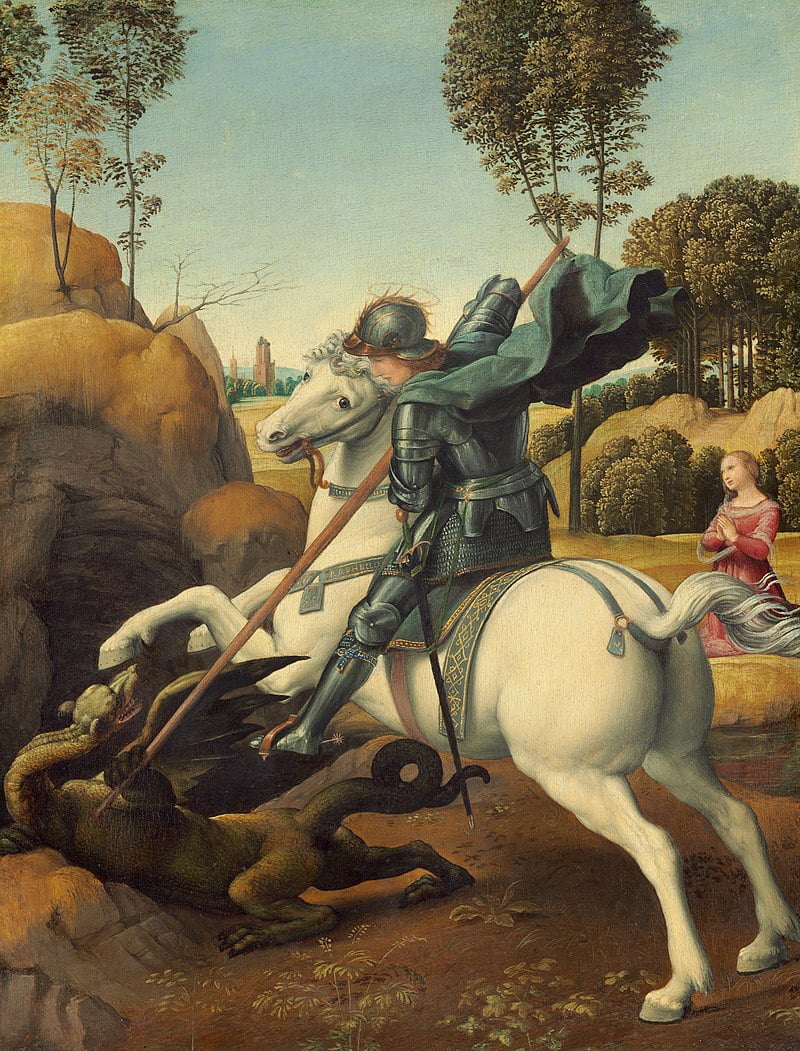
The story goes that a dragon had been terrorizing a town, demanding a daily sacrifice of a young maiden. On the day the king’s daughter was to be sacrificed, Saint George, riding a white steed, appeared. He valiantly wounded the dragon and saved the princess. He then used this opportunity to preach Christianity to the people and converted them. In gratitude, they abandoned their pagan beliefs, and the dragon was slain.
This legend, rich in symbolism, is often interpreted as the victory of good over evil, with Saint George representing Christianity’s triumph over paganism. The dragon represents the devil or evil, and its defeat showcases the protective power of faith.
Art has celebrated this legend extensively. Raphael’s “Saint George and the Dragon” is a masterpiece that vividly brings this tale to life. The painting captures the moment of climax, with Saint George on horseback, lance in hand, battling the fearsome creature. The fair maiden, often depicted in the background, watches the scene, symbolizing humanity’s hope and faith in divine intervention. You can view this masterpiece at National Gallery of Art in Washington.
Another noteworthy depiction is by the artist Uccello, where the battle is portrayed in a more stylized manner, highlighting the saint’s valor and the dragon’s menacing form.
Saint George’s story, both his martyrdom and his legendary battle, serves as an inspiration. It reminds believers of the power of faith, the eternal battle between good and evil, and the protective power of the saints. His veneration as a warrior saint, especially in regions like England, where he is the patron saint, showcases the universal appeal of his story and his virtues.
In conclusion, Saint George, through his life’s stories and artistic depictions, remains a beacon of courage, faith, and righteousness.
Saint Blandina: The Courageous Martyr of Lyon
Blandina, one of the most revered martyrs in Christian history, stands as a testament to unwavering faith. Her story is one of immense courage, resilience, and devotion to her beliefs, even in the face of excruciating torment.
Born as a slave in the 2nd century AD in Lyon, France, Blandina was a devout Christian. At the time, the Roman Empire was undergoing one of its periodic bouts of persecution against the Christians, and Lyon was no exception. The city’s Christian community, of which Blandina was a part, faced severe harassment and violence.
The details of her martyrdom are recorded in a letter sent from the Church of Lyon to the churches in Asia Minor. During the persecutions, many Christians were arrested, including Blandina and her master. While in prison, she was reportedly tortured for her beliefs but remained steadfast. Witnesses claimed that she seemed to feel no pain and instead appeared as if in a trance, drawing strength from her profound faith.
One of the most iconic parts of her martyrdom was when she was placed in an amphitheater, exposed to wild animals as part of the public games. Instead of being mauled, the animals reportedly did not touch her, leaving the audience in awe. This, however, did not save her. She was later crucified and then thrown to a wild steer, which led to her death.
Blandina’s story of perseverance and strength resonated deeply with early Christians. Her martyrdom served as a poignant reminder of the sacrifices made by early followers of Christ and the strength of their conviction.
In art, Saint Blandina is often depicted in the throes of her martyrdom, usually tied to a stake or in the presence of wild animals, emphasizing her bravery and unwavering faith. Such depictions served to inspire generations of Christians to stand firm in their beliefs, even when faced with adversity.

Saint Francis of Assisi: The Nature-loving Friar
Saint Francis of Assisi, born in 1182 in Assisi, Italy, remains one of the most venerated religious figures in history. His deep connection to nature, his commitment to a life of poverty, and his passion for peace have made him a universal symbol of simplicity and devotion.
Born into a wealthy merchant family, young Francis enjoyed a life of luxury and indulgence. However, a series of events, including a stint as a prisoner of war and a severe illness, led him to undergo a profound spiritual awakening. He renounced his worldly possessions, embraced a life of poverty, and set out to live according to the Gospel.
One of the most iconic stories surrounding Saint Francis is his sermon to the birds. As the tale goes, while traveling with some companions, Francis came upon a place with a large number of birds. Rather than continue on his way, he decided to preach to them, urging them to be thankful to God for their colorful coats and the freedom of flight. This deep connection to animals and nature earned him the title of patron saint of animals and the environment.
Saint Francis also founded the Franciscan Order, a religious order dedicated to the principles of humility, simplicity, and poverty. The members of this order, known as Friars, sought to live in harmony with all of God’s creation.
His commitment to peace is also well-documented. It is said that during the Crusades, Saint Francis traveled to Egypt and met with the Sultan in an attempt to secure peace. While he did not succeed in ending the conflict, his brave and peace-loving approach was noteworthy.
In art, Saint Francis is often depicted in humble attire, surrounded by animals or in contemplative prayer. One of the most famous paintings of him is “St. Francis in Ecstasy” by Giovanni Bellini, capturing the saint’s deep spiritual experiences.

Saint Francis of Assisi passed away in 1226, but his legacy continues to inspire millions around the world. His teachings on simplicity, love for all creatures, and commitment to peace remain relevant even today.
Saint Thomas Aquinas: The Scholarly Saint
Among the great theologians of the Catholic Church, Saint Thomas Aquinas holds a preeminent position. Born in Italy in the 13th century, Thomas was an incredibly learned man, and his contributions to philosophy and theology are unparalleled. He combined the theological principles of faith with the philosophical principles of reason, laying foundational elements of Christian scholasticism.
His most significant work, the “Summa Theologica,” is a comprehensive exploration of Christian theology. Within its pages, Thomas delves deep into profound questions about God, creation, morality, and the nature of man. He demonstrated an ability to balance faith with intellectual rigor, making his works resonate even outside religious circles.
Artistically, Saint Thomas Aquinas has been depicted in various settings. One of the most notable paintings is “Triumph of Saint Thomas Aquinas” by Benozzo Gozzoli. The fresco portrays Thomas seated and surrounded by philosophers, symbolizing his role as a bridge between faith and reason.
Today, Thomas’ teachings continue to influence Catholic theology and philosophy. His ability to unify reason with faith, to challenge and engage with non-Christian ideas, and to produce a body of work that speaks both to scholars and the common man, marks him as one of the greatest saints of the Church.
Saint Anthony of Padua: The Miracle Worker
Saint Anthony of Padua, often referred to as the “Wonder-Worker,” is one of the most popular saints in the Catholic tradition. Born in Portugal, he later moved to Italy, where he spent a significant part of his life preaching, teaching, and performing miracles.
Anthony had an eloquent way of speaking, and his sermons drew vast crowds. His deep knowledge of the Scripture, combined with his charismatic oratory, made him a revered figure during his time. He is often invoked for finding lost items, not just because of his ability to locate physical objects, but also for his skill in guiding souls back to God.
In the realm of art, Saint Anthony is often depicted holding the child Jesus, symbolizing a vision he had where he held the infant Lord in his arms. El Greco’s “St. Anthony of Padua” is a prime example of this iconic representation.

The legacy of Saint Anthony is enduring. His teachings and sermons continue to inspire, and his status as a miracle worker makes him a beacon of hope for many. His ability to touch the hearts of the common people, to heal and to guide, marks his indelible contribution to the Catholic faith.
Saint Therese of Lisieux: The Little Flower of Jesus
In the vast garden of Catholic saints, Saint Therese of Lisieux, often referred to as “The Little Flower,” shines with a unique, delicate radiance. Born in 1873 in France, her life was a brief yet impactful 24 years. Despite her short life, her profound spirituality and “The Little Way” philosophy made her one of the most venerated saints of modern times.
Therese believed in doing small acts with great love. Rather than grand gestures or significant sacrifices, she emphasized the importance of daily, humble acts of love and kindness. Her autobiography, “The Story of a Soul,” chronicles her spiritual journey and has inspired countless individuals worldwide.
Artistic representations of Saint Therese often portray her in the Carmelite habit, holding a bouquet of roses or a crucifix, symbolizing her devotion and the spiritual “roses” or blessings she promised to send after her death. “Saint Therese of the Child Jesus and the Holy Face” by Celine Martin, her own sister, captures Therese’s gentle spirit beautifully.
Her influence is far-reaching. Despite her short life, her profound insights into faith and her approach to sanctity—accessible to everyone—have made her a beloved figure in the Catholic Church and beyond.
Saint Augustine of Hippo: The Converted Sinner
Few saints have a past as colorful as Saint Augustine of Hippo. Born in 354 AD in present-day Algeria, Augustine spent his early years seeking pleasure and intellectual satisfaction, famously praying, “Grant me chastity and continence, but not yet.” However, his restless heart eventually found its peace in God, leading to his baptism at age 31.
His work “Confessions” is a deeply personal account of his journey towards faith, making it one of the most significant spiritual autobiographies. Augustine’s other writings, especially “The City of God,” have left an indelible mark on Christian theology and philosophy.
In art, Saint Augustine is often depicted as a bishop with a burning heart, emphasizing his passionate love for God. Philippe de Champaigne’s “Saint Augustine” captures the saint’s introspective nature and depth of thought.
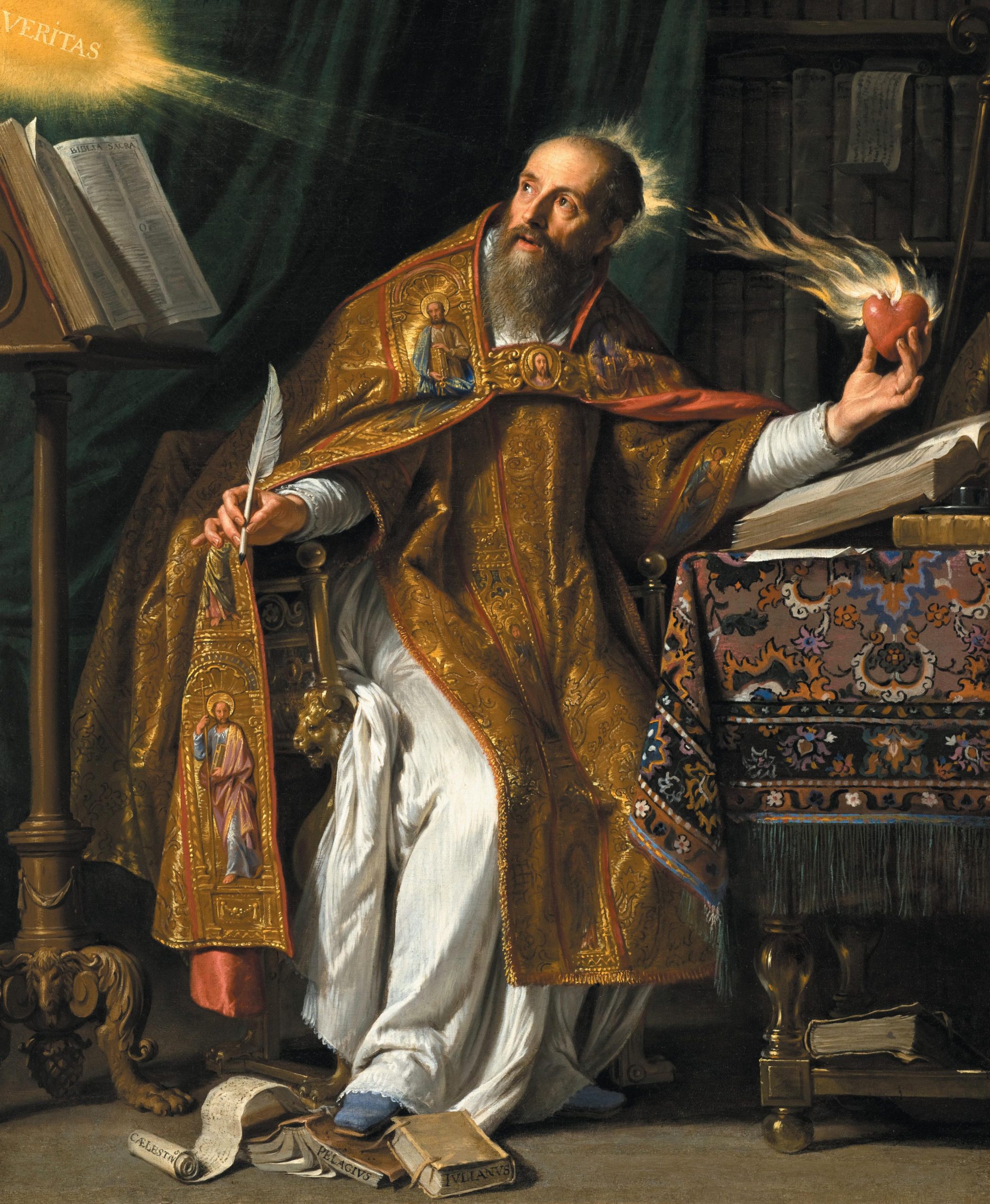
Augustine’s life is a testament to the transformative power of God’s love. From a life of hedonism to becoming one of the most influential theologians in Christian history, his journey inspires many who struggle with their faith.
Saint Catherine of Siena: The Mystic and Political Activist
Saint Catherine of Siena, born in 1347, stands as a remarkable figure in Catholic history, not just for her deep spiritual insights but also for her active involvement in political affairs. A member of the Dominican Third Order, Catherine was both a mystic and a reformer, a combination seldom found in any era.
From a young age, Catherine experienced mystical visions, leading her to choose a life of piety and asceticism. However, it wasn’t just her spiritual life that defined her. She actively engaged with the world around her, corresponding with leaders, and even convincing Pope Gregory XI to return to Rome from Avignon.
In artworks, Catherine is often depicted holding a lily, a symbol of her purity, or wearing the crown of thorns, representing her profound identification with the sufferings of Christ. Tiepolo’s “The Mystical Marriage of Saint Catherine” beautifully encapsulates her divine union with Christ.
Catherine’s writings, especially “The Dialogue,” are profound theological works that delve deep into the nature of God and the soul’s journey towards Him. Her activism and intense spiritual life make her an enduring figure in the annals of sainthood.
Saint Ignatius of Loyola: The Founder of Jesuits
Born in 1491 in the Basque region of Spain, Saint Ignatius of Loyola’s initial aspirations were far from religious. As a young man, he dreamt of military glory, but a cannonball injury at the Battle of Pamplona in 1521 changed the course of his life. During his recovery, he underwent a profound spiritual conversion, which eventually led him to lay down his military ambitions and take up the life of a hermit.
Ignatius’s spiritual insights, gained during this period, formed the basis of the Spiritual Exercises, a set of meditations, prayers, and contemplative practices that have profoundly influenced Christian spirituality.
He went on to found the Society of Jesus (Jesuits), a religious order that would play a significant role in the Counter-Reformation and the spread of Catholicism globally. Jesuits are known for their educational, missionary, and charitable works around the world.
Artistically, Ignatius is often portrayed in the black cassock of the Jesuits, holding a book symbolizing his Spiritual Exercises. Rubens’ “Saint Ignatius of Loyola” captures the saint’s visionary spirit and determination.
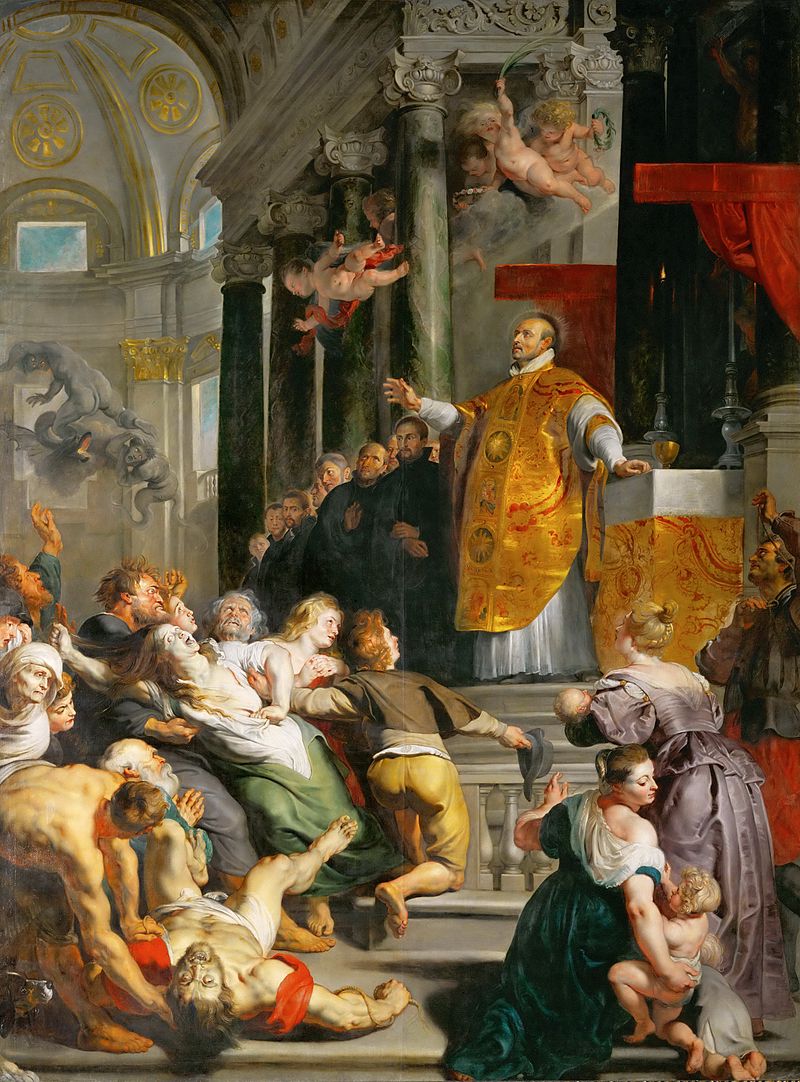
Ignatius’s legacy, both through the Jesuit order and his spiritual writings, continues to inspire and guide countless souls on their spiritual journeys.
Questions and Answers
Q: Why are saints so significant in Catholicism?
A: Saints are revered in Catholicism because they are believed to have led lives of exceptional holiness and virtue. They serve as role models for the faithful, illustrating how to live according to God’s will. Additionally, Catholics believe saints can intercede on their behalf, praying for them in heaven.
Q: Which saint is considered the ‘patron of lost causes’?
A: Saint Jude Thaddeus is commonly referred to as the ‘patron of lost causes’. He is invoked by many when all else seems hopeless.
Q: Are all saints canonized?
A: Not all saints are formally canonized. Canonization is the formal process by which the Catholic Church declares someone a saint. However, many saints were recognized as such by local communities before the official process was established.
Q: How does someone become a saint in the Catholic Church?
A: Canonization is a lengthy process that involves thorough investigation of the individual’s life, miracles attributed to their intercession, and their writings. It usually starts with the individual being declared a Servant of God, then Venerable, followed by Beatification (upon confirmation of a miracle), and finally Canonization (with a second miracle).
Q: Are there any paintings that depict the lives of multiple saints together?
A: Yes, there are many artworks that depict multiple saints together. These are often called “sacra conversazione,” meaning “holy conversation.” They usually portray the Virgin Mary and Christ Child surrounded by various saints. A notable example is Titian’s “Pesaro Madonna.”
Q: How are saints typically represented in art?
A: Saints are often portrayed with specific symbols, known as attributes, that represent their lives or the manner of their martyrdom. For example, Saint Peter is often shown with keys, symbolizing the keys to the kingdom of heaven.